Assess consistency across samples in a Kakobuy spreadsheet
One photo can tell you something about the item in it. Multiple observations may help you judge whether a detail is consistent, provided the samples are genuinely comparable. Store each observation as its own entry in your Kakobuy spreadsheet so the evidence retains its limits.
Define what shareable evidence looks like
Record the listing, selected variant, observation date, measurement points and photo conditions where available. Mark whether the source is a firsthand image of the piece or a general listing photo. A general photo can describe the intended appearance, while a firsthand measurement can describe the observed object. Those are different pieces of information. Watch for the same photo appearing in more than one report. Treat matching folds, background marks or identical tape placement as a reason to check whether the reports describe the same unit. Duplicated pictures deserve a single observation in your comparison. If you cannot resolve whether two images are independent, give both that note.
Narrow the comparison to one feature
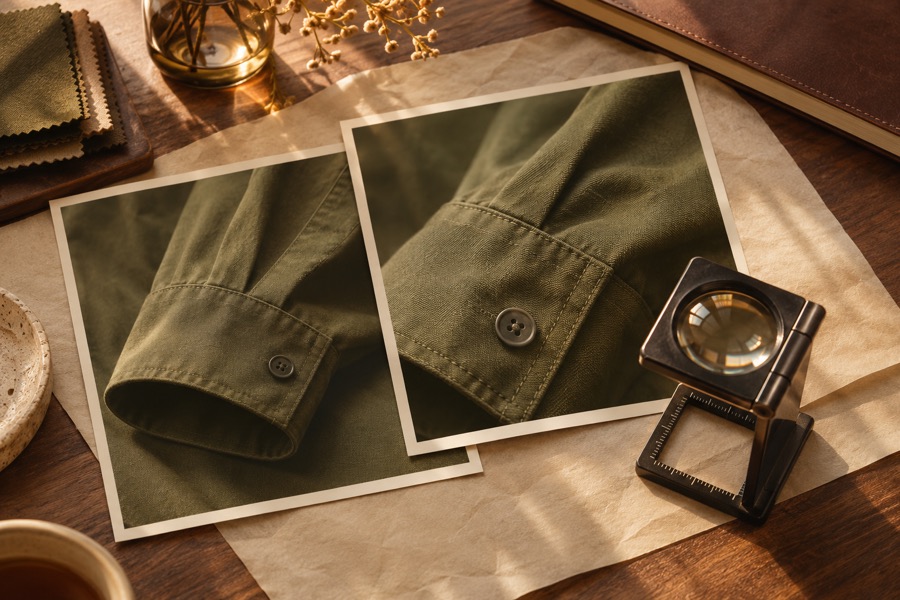
Suppose the question is whether the sleeve opening feels snug. Compare openings measured at the same point, laid flat with the fabric relaxed. A cuff pulled open for one photograph cannot tell you how wide it rests. If you are comparing stretch as well, record it separately and describe how the tape reading was obtained.
Use a small sample as a range
Three comparable widths of 9, 9 and 10 cm describe the observed range for those samples. If 10 cm is your comfort minimum, the historical observations leave that decision unresolved. The next useful evidence is a flat measurement for the particular item you are considering. An average would hide the difference that matters to you.
Save the scope of your finding
Write “three observed black M samples, 9–10 cm relaxed cuff” and include the dates. If there is a new variant or the construction appears to have changed, start its own comparison. This makes the note reusable without claiming it describes every future item.